

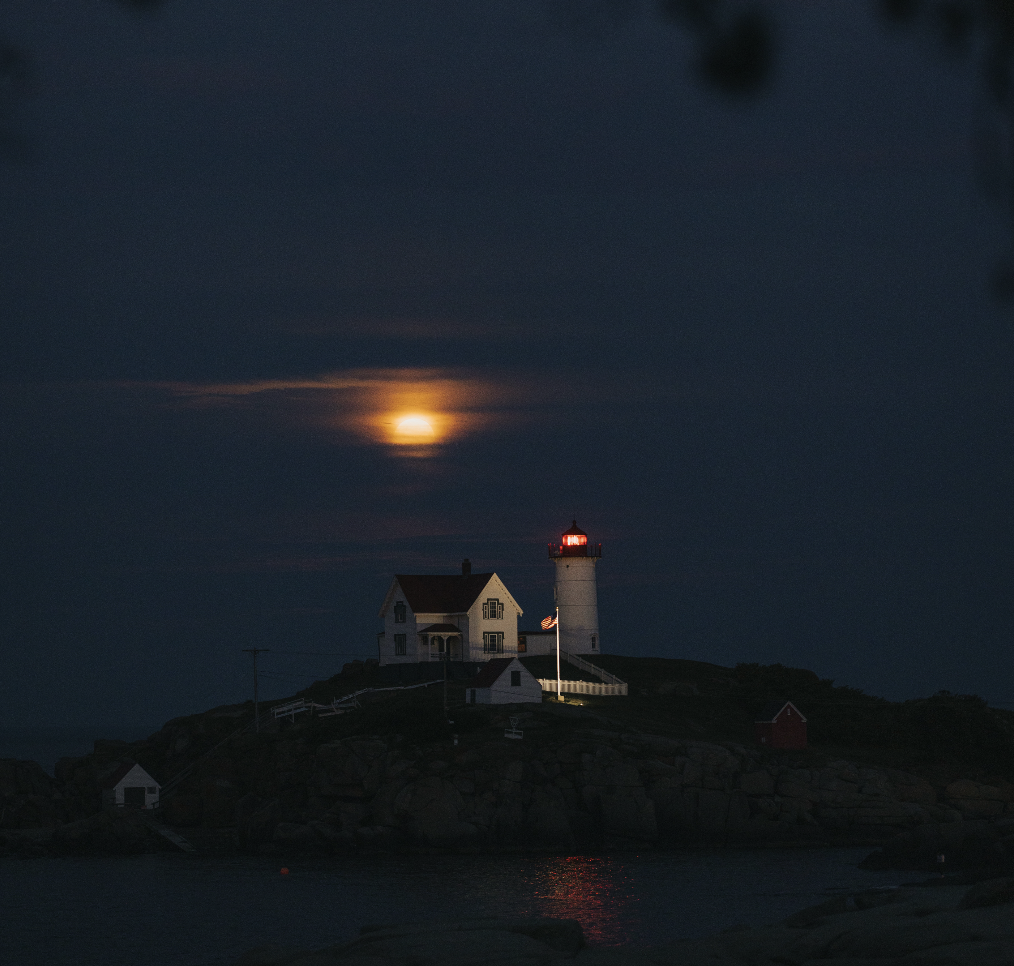
Photo by Organic Photography.
Long before electricity illuminated the coast of Maine, an ancient beacon guided ships across the Atlantic from the shores of northwestern Spain. The Tower of Hercules, in A Coruña, is the world’s oldest surviving Roman lighthouse still serving its original purpose. Built between the first century BC and the first century AD, it is believed to have used an enormous oil lamp and a parabolic mirror to project its light out to sea. Nearly two thousand years later, the same enduring idea remains: a light can do more than illuminate the darkness. It can guide us, reassure us, and help us find our way.
Here in York, Maine, our own beacon has a distinctive signature. Every six seconds, a red light appears above the Atlantic, shining from the rocky island known affectionately as the Nubble.
But why red?
A Color With a Purpose
Cape Neddick Light, better known as the Nubble Lighthouse, first illuminated the coast on July 1, 1879. Its 41-foot cast-iron tower was built to help mariners navigate this rugged stretch of shoreline, where rocky outcrops and unpredictable waters demanded reliable signals. Today, the lighthouse remains an active aid to navigation. Its red light flashes for three seconds, followed by three seconds of darkness, repeating in a six-second cycle.
The color is no accident. In maritime navigation, the color and rhythm of a lighthouse's signal help sailors identify a particular light and understand their position relative to the coastline. Red can distinguish one navigational light from another, including lights marking particular sides of channels or hazards. At the Nubble, red is the signature that makes this beacon unmistakable.
The technology behind that glow was once revolutionary. The Nubble originally used a fourth-order Fresnel lens, a French invention developed by physicist Augustin-Jean Fresnel in the 1820s and adopted widely by lighthouses during the nineteenth century. Unlike a conventional, bulky lens, the Fresnel design uses carefully arranged glass prisms to concentrate light into a powerful beam that can travel far across the water.
The Nubble's original lens used two lamps fitted with red globes to produce its red warning light. The lens was damaged in an explosion in 1928 and replaced with a fourth-order Fresnel lens from another station. Today, the lens is encased in red plastic to preserve the distinctive color of the beacon.
For generations of mariners, that red glow carried practical meaning: pay attention, know where you are, and navigate with care. Yet stand on the shore today, watching the light emerge against the deep blue of the ocean, and it can evoke something entirely different.
From Warning to Wonder
For many of us, the Nubble's red light is not a warning at all. It is a familiar point of reference, a quiet presence at the edge of the sea. It marks the passage of evening, catches the eye through coastal fog, and offers a reassuring sense of continuity in a landscape that is otherwise always changing.
Perhaps that is the curious power of color: its meaning is never entirely fixed. The same red that once signaled caution to a sailor can now inspire wonder, warmth, and calm in someone watching from shore.
At The Viewpoint, we have taken inspiration from that transformation.
